Celtic supporters view recent pitch-invasion coverage as inconsistent with past reactions to attacks on Neil Lennon and Celtic staff.
- Police Scotland said no assault reports were made after Celtic’s title celebrations.
- Cammy Devlin indicated no Hearts players were injured after the Celtic Park pitch invasion.
- Neil Lennon was attacked at Tynecastle, hit by a coin at Hibs and sent bullets and explosive devices.
- A Celtic staff member needed stitches after being struck by a bottle at Ibrox.
- Two Rangers supporters appeared in court accused of assaulting Celtic staff and striking Arne Engels with a coin.
Scottish football should be capable of holding two thoughts at once.
Violence is unacceptable.
And media coverage should be fair.
Those principles are not contradictory. In fact, they depend on one another.
No reasonable Celtic supporter defends violence. No reasonable supporter defends missiles being thrown, attacks on players, staff, managers or supporters, regardless of club allegiance. If a Celtic supporter assaults someone, they should face the consequences. If a Rangers supporter assaults someone, exactly the same standard should apply.
The problem is not accountability.
The problem is consistency.
Because when many Celtic supporters look back over the last decade, and indeed the last forty years, they see a pattern that is becoming increasingly difficult to ignore.
A pattern where incidents involving Celtic generate days, sometimes weeks, of outrage, condemnation, front-page headlines, television debates and demands for punishment.
While incidents involving Rangers often seem to disappear from public consciousness far more quickly.
That perception did not emerge from nowhere.
Neil Lennon was attacked on the touchline at Tynecastle.
Neil Lennon was struck by a coin while managing Hibernian.
Neil Lennon received bullets and explosive devices through the post.
A Celtic staff member required stitches after being struck by a bottle at Ibrox.
Objects were thrown onto the pitch towards Joe Hart.
A Rangers supporter has appeared in court accused of assaulting a Celtic staff member following a pitch invasion.
Another supporter has appeared in court accused of striking Arne Engels with a coin.
These are not opinions.
These are incidents that were reported, investigated and in some cases prosecuted.
Yet ask yourself a simple question:
Did any of these stories generate anything close to the level of sustained outrage that followed Celtic supporters entering the pitch after winning the league?
The answer is obvious.
For days after Celtic’s title celebrations, Scottish football seemed consumed by a single narrative.
The language was extraordinary.
“Tainted title.”
“National embarrassment.”
“Assaults.”
“Disgrace.”
“Points deductions.”
The reaction created the impression that Scottish football had witnessed something unprecedented.
But had it?
Pitch invasions are not unique to Celtic.
They happen across football.
They happen throughout Britain.
They happen throughout Europe.
They happen after promotions, relegation escapes, cup wins and title triumphs.
The events at Celtic Park deserved criticism.
The club accepted that.
Most supporters accepted that.
But criticism quickly became something else.
It became a frenzy.
And the deeper question is why.
When Allegations Matter More Than Evidence
Perhaps the most troubling aspect of the coverage was the speed with which allegations became accepted as fact.
Claims of assaults dominated headlines.
Pundits discussed incidents as though conclusions had already been reached.
Social media exploded.
Broadcasters devoted hours to discussion.
Yet as more information emerged, certainty became harder to justify.
Police Scotland stated that no reports of assaults had been made.
Hearts midfielder Cammy Devlin later indicated that no Hearts players had been injured.
Those facts should have prompted a significant shift in the discussion.
Instead, many supporters were left with the impression that the allegations generated infinitely more attention than the subsequent clarification.
That matters.
Because journalism is supposed to follow evidence.
Not the other way around.
The Familiar Voices
Another reason many Celtic supporters distrust the coverage is the identity of those driving so much of it.
Again and again, the loudest criticism appears to come from the same small circle of pundits, former Rangers players and media figures.
Ally McCoist.
Kris Boyd.
Keith Jackson.
Jim White.
Others inevitably join the chorus.
None of these individuals should be prevented from expressing opinions.
That is not the issue.
The issue is balance.
When Celtic supporters hear accusations of corruption, references to “tainted titles” and endless speculation about Celtic victories, they are entitled to ask whether the same scrutiny is applied consistently across Scottish football.
Because too often it feels as though Celtic are expected to prove their innocence while others are granted the benefit of the doubt.
The Neil Lennon Question
Perhaps no figure better illustrates the imbalance than Neil Lennon.
Few individuals in modern Scottish football have endured what Lennon endured.
Physical attacks.
Death threats.
Bullets sent through the post.
Explosive devices.
Coins thrown from crowds.
Sectarian abuse.
For years, many Celtic supporters felt those stories never generated the national reckoning they deserved.
There was condemnation, certainly.
But nowhere near the sustained outrage that often accompanies controversies involving Celtic supporters.
Why?
Why were some incidents treated as isolated acts while others become symbols of a wider social crisis?
Why does one story dominate headlines for weeks while another disappears after days?
Those are legitimate questions.
The Shadow Scotland Still Refuses To Confront
And eventually the discussion reaches a place many in Scottish football would rather avoid.
Sectarianism.
Not because every criticism of Celtic is sectarian.
That would be absurd.
Nor because every journalist, pundit or broadcaster is motivated by prejudice.
Most are not.
But Scottish football does not exist in a vacuum.
Celtic’s origins are tied to Irish immigration.
To Catholic communities.
To people who historically existed outside Scotland’s traditional establishment structures.
That history matters.
It always has.
The uncomfortable reality is that anti-Irish and anti-Catholic prejudice did not simply disappear because Scotland became more modern.
Many attitudes softened.
Some disappeared.
Others merely evolved.
Which raises difficult questions.
Would another club receive the same treatment?
Would another support face the same assumptions?
Would another title celebration generate the same national outrage?
Nobody can answer those questions with certainty.
But the fact so many Celtic supporters continue asking them tells its own story.
Accountability Cannot Be Selective
The central issue is not Celtic.
It is standards.
If violence is wrong, condemn all violence.
If assaults matter, then every assault should matter.
If fan behaviour deserves scrutiny, every support should face scrutiny.
If evidence matters, evidence should be required before accusations become headlines.
Those principles should not depend on the colour of a shirt.
Yet too often Scottish football appears to operate differently.
The result is predictable.
Trust erodes.
Supporters become cynical.
Media credibility suffers.
And every new controversy becomes another battle in an already toxic culture war.
The Question Nobody Wants To Answer
Perhaps the biggest question is also the simplest.
Why do so many Celtic supporters feel they are judged differently?
Not occasionally.
Not during isolated incidents.
Consistently.
Across decades.
Across generations.
Across different broadcasters, newspapers and pundits.
Maybe the answer lies in football rivalry.
Maybe it lies in commercial incentives, where outrage drives clicks and ratings.
Maybe it lies in old cultural fault lines that Scottish society still struggles to confront honestly.
Or maybe it is a combination of all three.
Whatever the explanation, the perception exists.
And perceptions do not emerge from nowhere.
Scottish football desperately needs consistency.
Not protection for Celtic.
Not protection for Rangers.
Not protection for anyone.
Just consistency.
The same standards.
The same evidence.
The same scrutiny.
The same accountability.
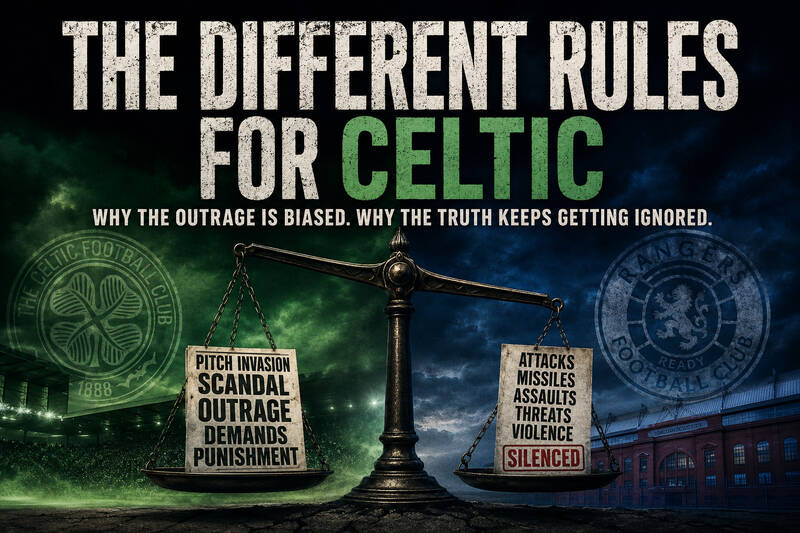
Because if one club’s pitch invasion becomes a national scandal while attacks, missiles, coins, bottles, threats and assaults elsewhere receive a fraction of the attention, supporters are entitled to ask whether the issue is really behaviour at all.
Or whether, after all these years, Scottish football still has different rules for Celtic.